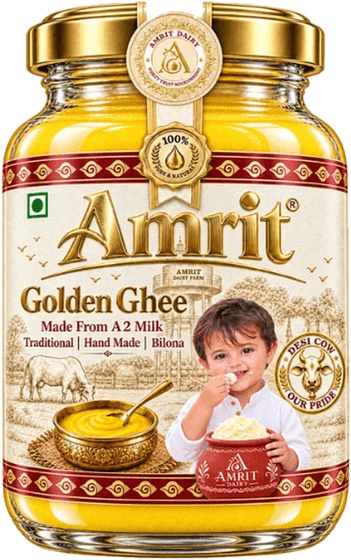
Ghee & Bilona
How to check if your ghee is pure: simple home checks
By Amrit Dairy Farm Team, Amrit Dairy, Sonipat · 26 September 2026 · 2 min read
Can you test ghee purity at home?
You can spot some common problems at home, but a home check is only a hint. Only a food-testing laboratory can confirm purity. FSSAI publishes simple kitchen tests in its DART book.
Check 1: Iodine test for starch
Take half a teaspoon of ghee in a transparent bowl, add a few drops of tincture of iodine (from a chemist) and mix. If the colour turns blue, starch (for example mashed potato) may have been added. Pure ghee does not turn blue.
Check 2: Melt it slowly
Warm a spoon of ghee on low heat. Good ghee melts quickly into a clear golden liquid with a pleasant, nutty aroma. A strong, unusual smell is a warning sign.
Check 3: Look at the texture
Bilona ghee often sets with a grainy (danedar) texture at room temperature. Texture changes with temperature, so do not rely on this alone.
When should you use a lab?
If you suspect adulteration, send a sealed sample to an FSSAI-notified food-testing laboratory. At Amrit Dairy we are happy to answer any question about how our ghee is made.
Key takeaways
- Home checks give hints only
- Blue colour in the iodine test suggests starch
- Lab testing is the only final answer